
You have a seminar ticket and a doubt
If you are searching “are property investment seminars worth it”, you probably have a ticket in your inbox and a bad feeling in your stomach. I know that feeling.
In our first two years in Australia, Reshmi and I put about $80,000 on credit cards and personal loans. Almost all of it paid for courses and seminars. Some of that money changed our lives. Some of it bought us a long sales pitch and a weak coffee.
So here is the honest answer, from someone who has sat through the good ones and the bad ones.
Why so many people end up at property seminars
When we arrived in 1997 there were no property podcasts. No YouTube. Nobody around us knew how people built wealth through property. We started with books, then seminars, because that was the only way to learn.
Today it is the opposite problem. Information is everywhere, and a lot of it is noise. I call it tick tock trends. Someone makes a bold promise in a short video and a crowd follows it. Seminars still play the same role they always did. They promise a shortcut through a confusing subject.
The fear underneath is real. What if I choose wrong? What if I get ripped off? A seminar looks like the answer to that fear. Sometimes it is. Sometimes it is the cause.
So, are property investment seminars worth it?
Some are. Most are built to sell you something. The seminar is not the problem. What you do with it is.
Reshmi and I went to seminars no matter who was presenting. Most of the time the speaker wanted to sell their own stock. We still came away with knowledge, and we did not get sucked into buying.
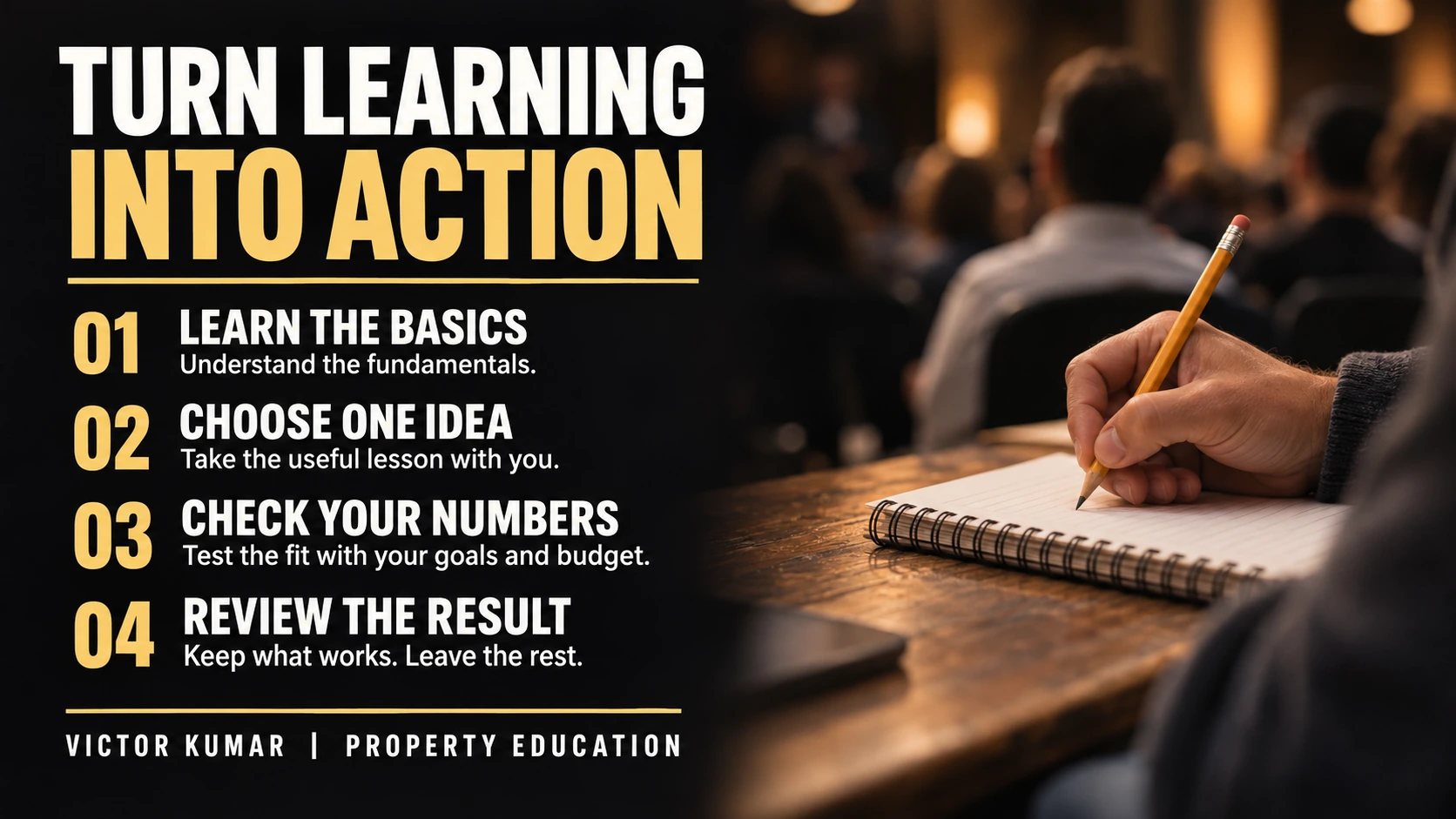
That became our rule. Take the good and leave the rest. We tried one idea from each seminar. If it worked, we kept it. If we did not like it, we dropped it.
What was worth the money
The best thing we ever paid for was not a property strategy. It was one weekend of personal development. After the noise and the fire walk (Anthony Robbins), we stayed up most of the night. We wrote down our own goals, then merged them into one list. We found where our goals matched, and where one of us needed to support the other.
That list gave us our true why. Then we worked on the how, and then the where. I would say we are where we are because of that weekend. We still have the list, and most of it is ticked off.
Education paid for itself in a quieter way too. We read books and passed them back and forth. We did courses, and then we actually used what we learned. Phil Tarrant once joked that we had paid for two MBAs in property. He was not far off.
The seminar idea I would not repeat
One weekend seminar taught a strategy. Buy off the plan under an option, then sell the contract on before settlement. It cost us a lot, and our cards were close to maxed out afterwards.
I bought a cheap suit and walked into real estate agents’ offices around Sydney. Most had no idea what I was talking about. One did, and his vendor was a solicitor who understood it. We tied up seven townhouses using deposit bonds. We brought in friends as joint venture partners to cover the rest, and we sold most of them on. It paid out our education loans.
It was also hugely risky. Reshmi and I made a pact. If it all went wrong, we would go back to where we started, with almost nothing. We had nothing to lose.
Most people starting out do have something to lose. I would not recommend this strategy to anyone, and the rules have changed. In most states you now pay stamp duty twice on a deal like that.
The lesson is not that seminars are bad. A strategy built for a stage is not built for your bank balance.
The people who went to every seminar and did nothing
Some people we knew back then loved seminars. They were not doers. We would catch up over coffee and talk about property, and nothing happened. Even now people tell me they have listened to every podcast I have ever done. I ask how many properties they own. The answer is often, “I am still thinking about it.”
Learning is not the same as acting. If you collect ideas and never test one, you are paying for entertainment.
How to tell a seminar from a sales pitch
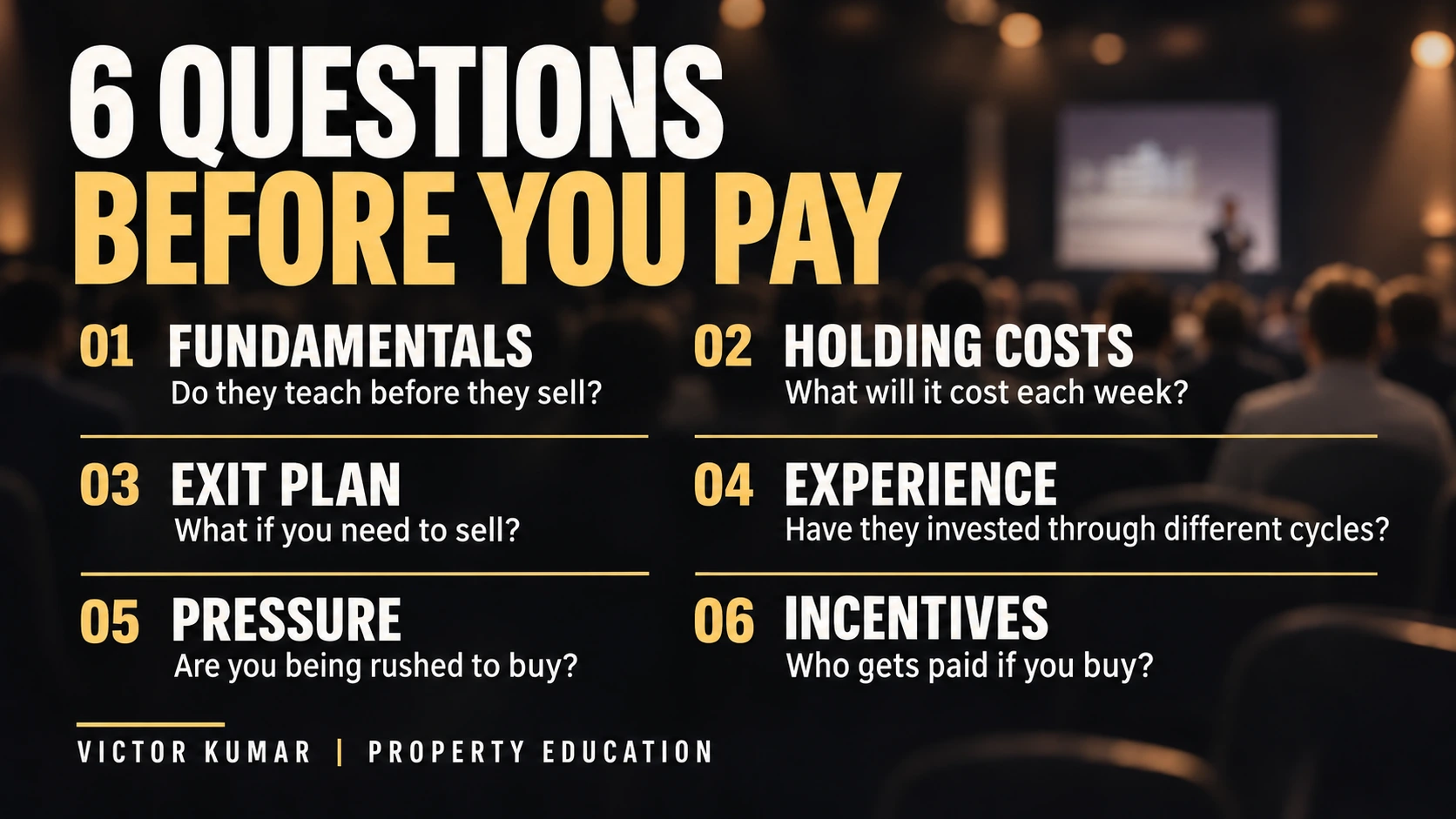
Ask these questions before you pay, and again while you sit there.
-
Does it teach the fundamentals before it shows you a property? You do not need every detail. You do need the basics, so you can judge what you are told.
-
Does the speaker talk about holding costs? Ask how much you would need to chip in each week to hold a property without hurting your lifestyle. If nobody mentions it, be careful.
-
Does anyone talk about selling? Assume every property you buy could go wrong. You should be able to sell and walk away with your money in any market. A seminar that never mentions the exit is showing you one side only.
-
Has the speaker been through more than one market cycle? Ask whether they are a product of one boom or of many cycles.
-
Are you being rushed? A countdown clock and a “today only” price are signs of a pitch, not a lesson.
-
Who gets paid if you buy? Ask the question out loud.
What I would do today instead
Start with a goal you can touch. Our property investment life goal setting guide is a good place to begin. Not “a million dollars in five years”. Try this: how much income would buy back one day a week of your time?
Then check with a broker who understands investors how much you can borrow and how much you can afford to hold. Do that before you ask where to buy. Once you know your numbers, the right question is not where. It is what.
If you are still working out whether property is for you at all, read why invest in property first.
Learn the basics from free sources, and ask questions of people who have done it themselves. Look for teachers who have invested through more than one market, and who will tell you their mistakes as well as their wins.
If you want all my learning and mistakes in one place, my book, Super Charge Your Property Portfolio, holds my decades of investing experience.
Frequently asked questions
Are free property investment seminars worth attending?
They can be, if you treat them as a sales event. Take notes, learn what you can, and do not buy anything on the day. Sleep on it.
How much do property investment seminars cost?
It varies a lot. I can only tell you what we spent, which was about $80,000 over our first two years on seminars and courses, paid on cards and loans. That is not a benchmark, and I would not suggest borrowing to pay for education when information today is so readily available.
What is a property spruiker?
Someone who hypes property to sell you something, usually with big promises and few numbers. A good test is whether they will show you the holding costs and the exit.
Do I need a seminar to start property investing?
No. You need education, because education takes away fear and makes you careful in the right places. It can come from books, podcasts, a mentor or a good workshop.
Should I buy a property on the day of a seminar?
No. Most of the time the speaker wants to sell you their own stock, and a rushed decision is the most expensive way to learn. Take notes, go home, check your numbers and sleep on it. If an offer only exists today, treat that as a warning sign.
How can I tell if a seminar speaker is credible?
Ask whether they have been through more than one market cycle, whether they talk about holding costs and selling as well as buying, and whether they share their mistakes as well as their wins. Then ask the question out loud: who gets paid if you buy?
This is general information only and not financial advice. Speak to a licensed professional before you make any investment decision.